
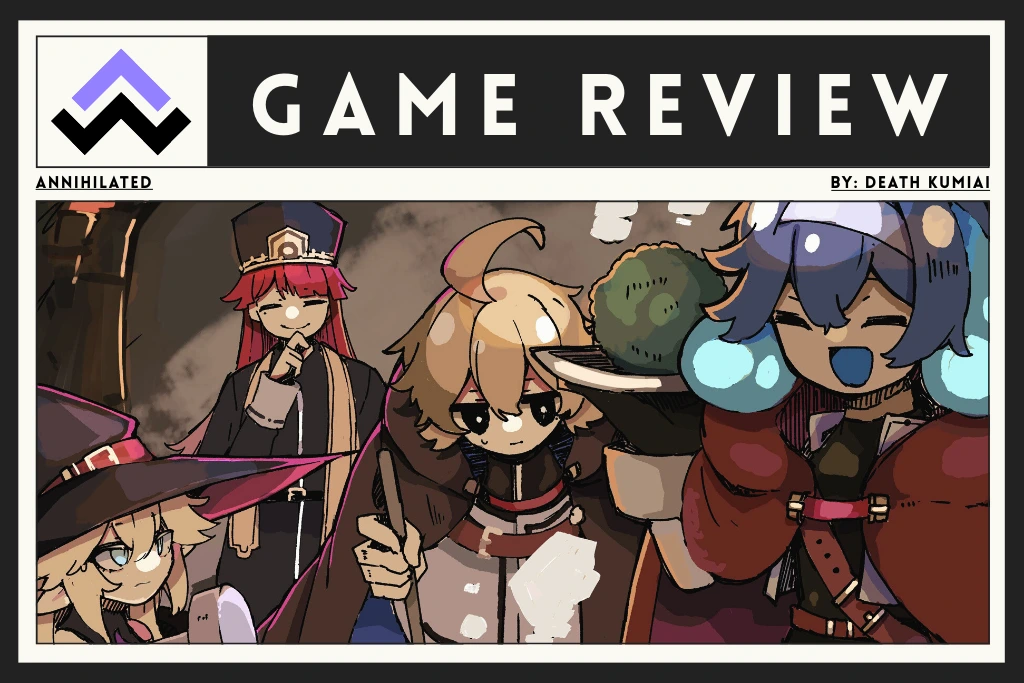

Annihilated is a fusion of visual novel storytelling and timing-based roguelite card combat. From the first choice, it makes its themes clear: survival demands sacrifice. The demo isn’t without rough edges, but its systems are impressively aligned with its narrative intent.
Annihilated Review
Release date: July 21, 2026
Reviewed on: Windows
Time played: 1+ hour
Developer: Death Kumiai
Choosing Who Gets to Live With You
Before the main plot unfolds, you face the game’s central cruelty: you can save only one companion. The Hero’s party lies shattered at the bottom of a dungeon with no means to escape. The monsters are not the point. The point is what’s left.
The choices are striking:
- The Hero has lost the ability to speak, responding only with “Yes” or “No”
- The Mage has lost her magic, heart pierced by a spike.
- The Warrior has lost his body, soul trapped in a doll.
- The Priest has lost his sanity, or perhaps discovered something beyond it.

Annihilated establishes itself as a visual novel first, although unlike Z.A.T.O., this one has combat and RPG elements. Dialogue, internal monologue, and branching choices dictate both plot and gameplay. Each route is a two-person journey: the one you rescue and yourself. The others remain behind, a decision the game reinforces through recurring narrative callbacks.
Each companion route diverge mechanically and tonally, even within the demo’s limited scope. Those initial character conditions meaningfully shape how each path unfolds. The Mage has no magic, making her weaker in combat. However, her stats favour event-based checks, creating a different type of challenge.
The Priest’s route is the strangest of the four. There are UI manipulations and surreal dialogue creating discomfort, yet he is strong in combat. It’s the least relatable path emotionally, yet mechanically the strongest. By the end of my playthrough, I found myself disturbed at how comfortable I had become relying on him.
The first three characters are significantly harder to progress. Their stat spreads are fragile, their early encounters punishing. But their routes feel more emotionally grounded by contrast. The Priest offers an easier, though psychologically taxing, experience. It’s an intentional imbalance, I suspect. You trade comfort for strength, coherence for survival.
As a visual novel, Annihilated excels at character intimacy. As a horror story, it understands that loss of self is more frightening than any dungeon beast.
Timing Is Everything in Combat
Underneath the branching narrative sits a timing-based card battler with roguelite elements. It’s an unusual pairing, but it works better than I expected.
Combat uses cards for attacks or items, like healing potions. When activated, a gauge appears on-screen. You must click within a highlighted threshold to determine success. The gauge speed and window size are determined by base stats. For example, high Strength slows the gauge for strength-based weapons and widens the window

Missed clicks mean missed attacks. Perfectly timed swings sometimes hit multiple enemies. The system is fair as success and failure are clearly tied to preparation and execution, so you always know whether it was skill or misjudgment.
The roguelite design reinforces tension. Weapons are limited-use and destructible. A scavenged sword only lasts a handful of swings before breaking. To replenish your arsenal, you must find weapons in events or disarm enemies mid-combat. Disarming is nerve-wracking as it requires hitting a tiny threshold, but success rewards you with the enemy’s weapon. Failure may risk death if you’re low on health. This makes combat dynamic and strategic.
The two-person party composition further shapes encounters. Each companion brings unique stats and abilities: the Mage, even without magic, improves magic-oriented weapons, while the Priest has unconventional healing tied to sanity mechanics.
Exploration and story events also feature stat-based checks: survive a sanity test after seeing a figure hanging from a noose, evade a rain of arrows with agility, and more. Success probability depends on the unique stats of you and your companion. Bringing the Priest makes combat easier but destabilizes future sanity events. Every choice reshapes both the story and survival odds.
Curses, the Currency Without a Market
One system feels unfinished: Curses. They are earned primarily when weapon cards break, and the better the card, the more Curses you gain. They can be spent to reroll failed checks, creating a risk-reward loop: lose cards, gain a potential benefit.
However, Curses accumulate too quickly. By the end of my first main route, I had over 90, with little meaningful way to spend them beyond rerolls. Because negative outcomes are not as frequent and Curses are easy to acquire, they lose tension. There’s no shop, no high-cost late-game option, and no transformative purchase to justify hoarding.
The reroll system works well mechanically but the surplus undermines the design. An economy needs scarcity or compelling sinks and, currently, Curses feel like a mechanic awaiting expansion. As this is only the prologue and early arc demo, it’s likely a placeholder for future content.
Cute Presentation, Then Unsettling
The art direction deserves praise. Annihilated blends dark and cute aesthetics: pastel character designs set against oppressive dungeon backdrops. The Warrior’s doll form is charming with button eyes, delicate jointed limbs, and soft textures. But placed within the dungeon’s grim setting, it becomes unsettling.
The interface participates in horror too. There are moments (which I shouldn’t spoil) accompanied by text warping and flickering dialogue boxes. The Priest’s route particularly leans into UI manipulation in ways that unsettle without becoming unreadable.
The dungeon environment, however, is visually timid. Corridors of moss-covered stone walls and torch-lit passages dominate the demo. While atmospheric, the repetition dulls exploration. Dungeons could offer more imaginative spaces as seen in other similar mediums like Delicious in Dungeon. The underground lakes, towering forests, ecosystems thriving in darkness. Future chapters could better mirror the party’s psychological evolution with environmental variety.
The Emotional Cost of Saving Someone
What lingers after a run is the weight of your choice. You cannot save everyone, and the game reinforces this with callbacks to abandoned companions and dialogue hinting at what might have been. The roguelite structure encourages replay, but the narrative makes each route feel like a moral trade.
The first three routes are challenging and emotionally grounded. The Priest’s route offers mechanical advantage but psychological unease. Completing it (in demo) leaves a sense of complicity in something larger and less definable, a subtle form of meta-horror.
The game encourages reflection of whether optimal play aligns with moral comfort.
Final Verdict: Great
Annihilated demonstrates a confident vision, aligning story, mechanics, and theme around the central idea of compromise. Its visual novel storytelling is intimate and effective, while the timing-based card combat introduces strategic tension.
What sets the game apart is how it binds its systems to its thesis. The easiest route is not the kindest one. The strongest companion is not the safest. Each run asks the same question in a different form: who are you willing to leave behind?
The Good
- Thoughtful and impactful party composition
- Emotionally resonant and distinct character routes
- Combat mechanics tightly integrated with narrative choices
The Bad
- Curses economy underdeveloped
- Dungeon environments lacking visual and biome variety
FAQs
Annihilated is a hybrid of visual novel storytelling and timing-based roguelite card combat, focusing on narrative choices, party management, and strategic timing in combat.
Combat is card-based with a timing mechanic. Players click within a gauge to execute attacks, disarm enemies, or use items, with success influenced by character stats and companion abilities.
No, each run forces you to choose one companion to rescue, and the game reinforces the consequences of leaving others behind.


Respect each other, speak your mind, and focus on ideas, not individuals.