
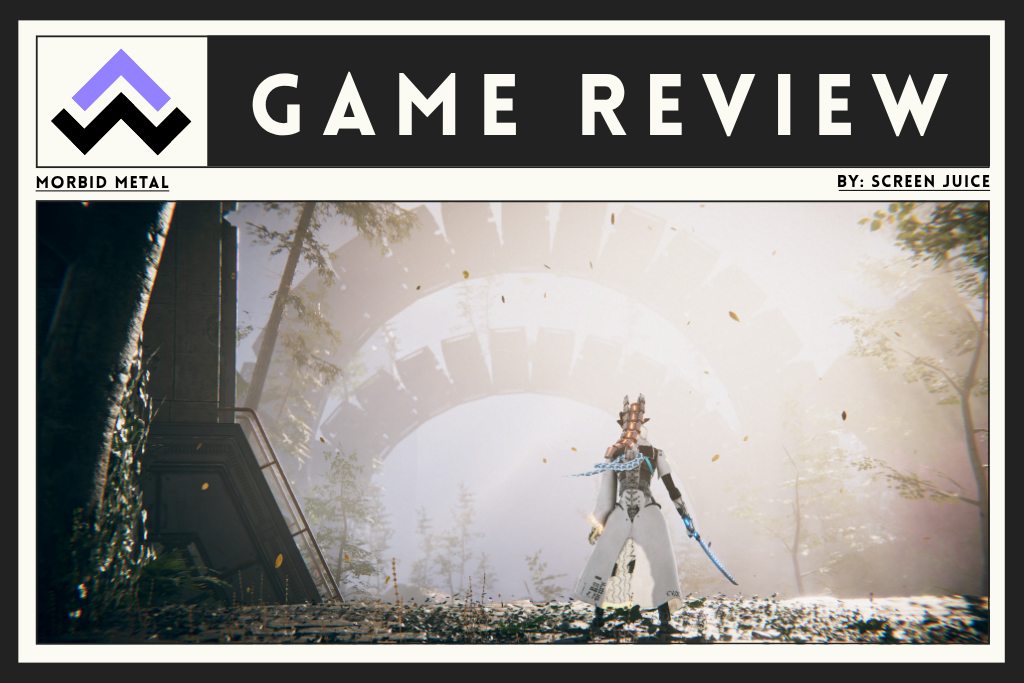

When you dive into a dark, post-collapse simulation and think you’ve mastered the battlefield, the game sends you back to square one. That’s the reality of Morbid Metal, a hack-and-slash roguelite where you shapeshift between characters with distinct playstyles.
Upon death, you begin a new loop (here called an “iteration”) revisiting the same biome again and again. It can be frustrating over time, but it’s also incredibly rewarding when you finally push past where you were previously stuck.
Morbid Metal Review
Release date: April 8, 2026 (on Early Access)
Reviewed on: Windows
Time played: 7+ hours
Developer: SCREEN JUICE
The setting of the game is rather enigmatic. You begin the tutorial as Flux, one of the AI forms you can shapeshift into, guided by a mysterious entity named Eden. Before you’ve had much time to understand the world, you’re thrown into your first iteration. As you progress through the opening biome, you unlock a second AI form, gradually expanding your combat toolkit.
Accesible Onboarding and First Impression
The onboarding is simple and effective, covering only combat and movement. That’s really all you need, there are no hidden mechanics waiting to trip you up. What became immediately clear to me was just how fast-paced the game is, relying heavily on your instincts for combos and dodging. After years without a truly satisfying character-action game, Morbid Metal instantly reminded me of classic Mecha games like Metal Gear Rising and Nier: Automata, capturing that same sense of momentum and style. In other aspect, it got that same Devil May Cry mayhem.
What hooked me early on was the framing of each run as an “iteration.” Functionally, it’s no different from a run or loop in other roguelites, but the terminology reinforces the game’s sci-fi simulation identity. It’s a small detail, but one that subtly strengthens your immersion and storytelling.

The first biome, Sublime Garden, is the kind of place that makes you stop mid-run just to take it in. Floating cliffs evoke an otherworldly feeling like in Avatar, rusty ruins hint at a lost civilization, and the arenas are staged with a cinematic flair that makes each encounter feel dramatic.
I should mention that I’ve been playing Morbid Metal on a PC that barely meets the recommended specs. The combat demands precision, so dropping frames is the last thing you want, but the world only really comes alive at higher graphical fidelity. This feels like a game that benefits heavily from stronger hardware if you want the full experience.
Shapeshifting Turns Action Into Expression
Beyond its presentation, what really keeps you engaged is how the game expands your options over time. Early in your iterations, you’ll encounter Ekku, a steel-bodied AI samurai dragging around a massive cleaver, and unlock him as a new form. If you push further into the second biome, you’ll gain access to Vekta, a slender, ninja-like humanoid with a very different combat role.
Shapeshifting isn’t the sole reason why Morbid Metal is unique. Actually, it’s more on how distinct each playstyle feels that elevates the gameplay. In an interview with the developer, Felix Schade explains how this system was designed to maximize player expression.
Flux is a precision-focused fighter, blinking behind enemies for quick, surgical strikes. Ekku trades mobility for raw power, excelling at heavy AoE damage. Vekta, meanwhile, plays more like a ranged controller, manipulating the battlefield with almost telekinetic force.
Switching between them mid-combat is when the chaos turns into art. I’ve spent hours experimenting with combinations, and I’m still finding new ways to chain abilities together. You can slam the ground with Ekku to launch enemies into the air, switch to Flux to blink through them with rapid strikes, and then, just before they hit the ground, shift to Vekta to pull them back up and slam them down again to finish the combo. It’s that level of fluidity and expressiveness that pushes Morbid Metal beyond what I usually expect from CAGs.
That said, this is still a roguelite, and each iteration pushes you toward adapting your playstyle based on the upgrades you find. This is where some of the game’s systems start to feel uneven.
Progression Systems: Void Nexus, Protocols, and Corpora
There are three main upgrade paths: Void Nexus, Protocols, and Corpora. Void Nexus functions as a standard skill tree, offering incremental, permanent upgrades over time. Protocols and Corpora, however, are run-based modifiers that shape how you play within each iteration.

Protocols are character-specific, often modifying skills or ‘ultimate’ abilities, and they appear frequently enough that you can usually build around them. You also have routine enhancement that further augment your Protocols. Corpora, on the other hand, is where things get frustrating. While it acts as a buff system, unlocking new Corpora requires a significant investment of Void Matters (the in-game currency), and actually finding them during a run is heavily RNG-dependent.
You can equip up to three Corpora per run, with upgrades allowing you to expand that capacity. But increasing your pool only seems to dilute your chances of getting the ones you actually want. There’s no way to curate or exclude unwanted options, and in practice, I often struggled to even fill all three slots with anything meaningful. It’s a system with interesting potential, but right now it feels too inconsistent for me to reliably engage with.
Despite this, the game itself is surprisingly accessible. It took me 13 iterations, each around 20 minutes, to defeat the first boss. For comparison, it took me over 10 hours and 12 deaths to overcome the first major hurdle in Returnal. Regular encounters are manageable, and it’s entirely possible to reach the boss without taking much damage.

Ironically, the biggest threats aren’t the enemies themselves, but the environment. I lost more health to falling off the map or getting clipped by bullet-hell-ish hazards than I did in combat. It’s less a design flaw and more a personal skill issue.
The bosses, however, are where the real challenge lies. These are multi-phase encounters that require you to learn patterns, adapt quickly, and stay focused. Once you understand their flow, and if you happen to get favorable Protocols and Corpora, they become manageable. But they still demand attention in a way that standard encounters don’t.
After unlocking the second biome, the first biome itself evolves. New environmental hazards are introduced, layering additional bullet-hell elements into previously familiar arenas. There’s more lasers, also more pressure, and definitely more room for error. While this keeps earlier areas from becoming stale, it also adds a certain friction when you’re trying to push forward. Just when it feels like you’re ready to move on, you’re forced to relearn spaces that were once comfortable.
On a lower-end PC, this becomes a different issue. The added environmental complexity also impacts performance, with more elements on screen dragging down the framerate at the worst possible moments.
Final Verdict: Great
With that said, I’ll need to upgrade my hardware before delving further into the second biome, because Morbid Metal clearly demands both mechanical skill and a system that can keep up. At its core, this is a fast, stylish roguelite built around expressive, character-action combat, with the shapeshifting system standing out as its defining strength.
But while the combat loop is consistently engaging, its progression systems don’t always land. Corpora feels too reliant on RNG to be worth investing in, and the increasing environmental hazards (paired with performance dips) can interrupt the flow more than they should.
Morbid Metal is best suited for players who enjoy high-speed, combo-driven gameplay and don’t mind repeating runs to refine their approach. If that loop clicks, there’s a lot to love here.
The Good
- Strong atmosphere and striking biome design
- Distinct playstyles that meaningfully expand combat options
- Expressive, fast-paced combat with seamless character switching
The Bad
- Corpora system is overly RNG-dependent
- Performance and environmental hazards can disrupt flow
ⓘ Review Disclaimer
We at GameWhims received a key for this game for free, this however didn’t impact our review in any way.
FAQs
Morbid Metal is a hack-and-slash roguelite where you shapeshift between multiple AI characters, each with unique combat styles.
You can switch between characters like Flux, Ekku, and Vekta mid-combat, combining their abilities for creative combos. Flux focuses on precision strikes, Ekku delivers heavy AoE damage, and Vekta manipulates enemies at range.
The game is accessible. Early iterations allow players to learn combat at a comfortable pace, and bosses are manageable with patience and strategy. Mastery emerges naturally as players explore shapeshifting and inter-character combos.



Respect each other, speak your mind, and focus on ideas, not individuals.