


So your kid is playing Persona 5, and on the surface it looks like any anime game about high school friendships and battling supernatural forces. Which… it is. But ratings exist because “on the surface” isn’t always the full picture.
This ESRB ratings guide helps you understand so you can make more informed decisions about games without needing to learn the entire gaming industry first.
And if you’re here hoping this will confirm that GTA VI is totally fine for younger players… this may not go the way you want.
Brief History of ESRB Ratings
The ESRB (Entertainment Software Rating Board) was created in the early 1990s in response to growing concerns about violent and sexual content in video games. Its purpose is to give consumers a clearer idea of what’s in a game before they buy it.
It’s used in the United States and Canada. In Europe, the equivalent system is PEGI (Pan European Game Information), which uses a different structure and rating style.
While ESRB ratings are part of an industry-managed system, they are widely adopted by console manufacturers and major retailers in North America. They’ve become the standard reference point for game content.
ESRB Ratings Chart: How to Read Them
There are three main things to look for:
- Rating Categories: Suggest age suitability
- Content Descriptors: Explain specific types of content that may be sensitive
- Interactive Elements: Highlight online or user interaction features
1. Rating Categories
There are five main rating categories, plus a couple of special cases used during development and marketing.
If you’re reading this via mobile, tap on each categories to flip the card for further details. On desktop, hover your pointer to auto-flip the card.

Everyone
Content is generally suitable for all ages. May include minimal cartoon or fantasy violence and infrequent mild language.
E.g: Minecraft and Mario Kart 8 Deluxe.

Everyone 10+
Suitable for ages 10 and up. May include slightly more cartoon or fantasy violence, mild language, and/or minimal suggestive themes.
E.g: Splatoon 3 and Super Smash Bros.

Teen
Suitable for ages 13 and up. May include violence, suggestive themes, crude humor, minimal blood, simulated gambling, and/or infrequent strong language.
E.g: Fortnite and The Legend of Zelda.

Mature 17+
Intended for ages 17 and up. May include intense violence, blood and gore, sexual content, and/or strong language.
E.g: Cyberpunk 2077 and The Last of Us.

Adult Only 18+
Suitable only for adults. May include prolonged intense violence, graphic sexual content, or gambling with real-world stakes. These titles are extremely rare in mainstream retail.
E.g: Hatred and Thrill Kill.
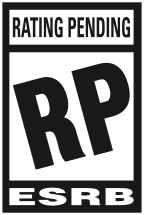
Rating Pending
Used in marketing and promotional materials before a final rating is assigned. It’s replaced once the official ESRB rating is confirmed.

Rating Pending – Likely Mature 17+
A provisional label sometimes used when a game is expected to receive an “M” rating, but hasn’t been finalized yet.
2. Content Descriptors
Content Descriptors give more detail about why a game received its rating. While the rating category tells you the general age suitability, descriptors highlight specific elements that might be worth a closer look.
Substances
| Alcohol Reference | Reference to and/or images of alcoholic beverages |
| Tobacco Reference | Reference to and/or images of tobacco products |
| Use of Drugs | The consumption or use of illegal drugs |
| Drug Reference | Reference to and/or images of illegal drugs |
| Use of Alcohol | The consumption of alcoholic beverages |
| Use of Tobacco | The consumption of tobacco products |
Blood/Gore
| Animated Blood | Discolored and/or unrealistic depictions of blood |
| Blood and Gore | Depictions of blood or the mutilation of body parts |
| Blood | Depictions of blood |
Humor
| Comic Mischief | Depictions or dialogue involving slapstick or suggestive humor |
| Mature Humor | Depictions or dialogue involving “adult” humor, including sexual references |
| Crude Humor | Depictions or dialogue involving vulgar antics, including “bathroom” humor |
Violence
| Fantasy Violence | Violent actions of a fantasy nature, involving human or non-human characters in situations easily distinguishable from real life |
| Violence | Scenes involving aggressive conflict. May contain bloodless dismemberment |
| Intense Violence | Graphic and realistic-looking depictions of physical conflict. May involve extreme and/or realistic blood, gore, weapons and depictions of human injury and death |
| Violent References | References to violent acts |
Gambling
| Gambling Theme | Prominently featured images or activities that are typically associated with real-world gambling even if they are not directly simulating a gambling experience |
| Simulated Gambling | Player can gamble without betting or wagering real cash or currency.Typically assigned to simulations of casino-based gambling. |
| Real Gambling | Player can gamble, including betting or wagering real cash or currency |
Language
| Language | Mild to moderate use of profanity |
| Strong Language | Explicit and/or frequent use of profanity |
| Lyrics | Mild references to profanity, sexuality, violence, alcohol or drug use in music |
| Strong Lyrics | Explicit and/or frequent references to profanity, sex, violence, alcohol or drug use in music |
Nudity
| Nudity | Graphic or prolonged depictions of nudity |
| Partial Nudity | Brief and/or mild depictions of nudity |
Sexuality
| Sexual Content | Non-explicit depictions of sexual behavior, possibly including partial nudity |
| Sexual Violence | Depictions of rape or other violent sexual acts |
| Sexual Theme | References to sex or sexuality |
| Suggestive Theme | Mild provocative references or materials |
| Strong Sexual Content | Explicit and/or frequent depictions of sexual behavior, possibly including nudity |
Keep in mind: Content Descriptors are not a complete checklist of everything in a game. They focus on the most notable or potentially sensitive content.
When a descriptor includes the term “Mild”, it indicates that the content appears with low frequency, intensity, or severity compared to standard versions of that descriptor.
3. Interactive Elements
Interactive Elements focus on a different aspect entirely. It focuses on how players interact with the game and with other people.
These labels do not affect the age rating, but they flag features that may matter for safety, privacy, or spending.
In-Game Purchases
Indicates that the game offers digital items or content that can be purchased with real-world money.
This can include cosmetic items (like skins), additional levels, virtual currency, subscriptions, season passes, or upgrades (such as removing ads).
In-Game Purchases (Includes Random Items)
This is a more specific version of the previous label.
It means players can spend money on items without knowing exactly what they’ll receive beforehand. Common examples include loot boxes, card packs, or mystery rewards.
For those concerned about gambling-like mechanics typically found in gacha games, this is the label to look out for.
Users Interact
Indicates that players can communicate or share content with others.
This may include text chat, voice chat, or user-generated content. Because interactions are not fully moderated, players may be exposed to unfiltered or uncensored content from other users.
Shares Location
Indicates that the game or app can display a user’s location to other players.
This is more common in mobile or AR-based games and may raise privacy considerations depending on how the feature is used.
Unrestricted Internet
Indicates that the game includes access to the broader internet, such as through a built-in browser or search functionality.
This means players could encounter content outside the scope of the game’s rating.
Online Music Not Rated by the ESRB
This label appears in music-based games.
It indicates that songs streamed or downloaded as additional content have not been rated, and their lyrics or themes were not considered when assigning the game’s ESRB rating.
FAQs
ESRB ratings started in 1994, after concerns about violence and mature content in video games.
There are 5 main ratings: E, E10+, T, M, and AO. There are also a few extra labels like “Rating Pending.”
No, they are not legally enforced, but most major consoles and retailers require them, so they’re widely followed.
ENJOYED THIS PIECE?
Add GameWhims as a preferred source on Google.
Jump to:

Respect each other, speak your mind, and focus on ideas, not individuals.