
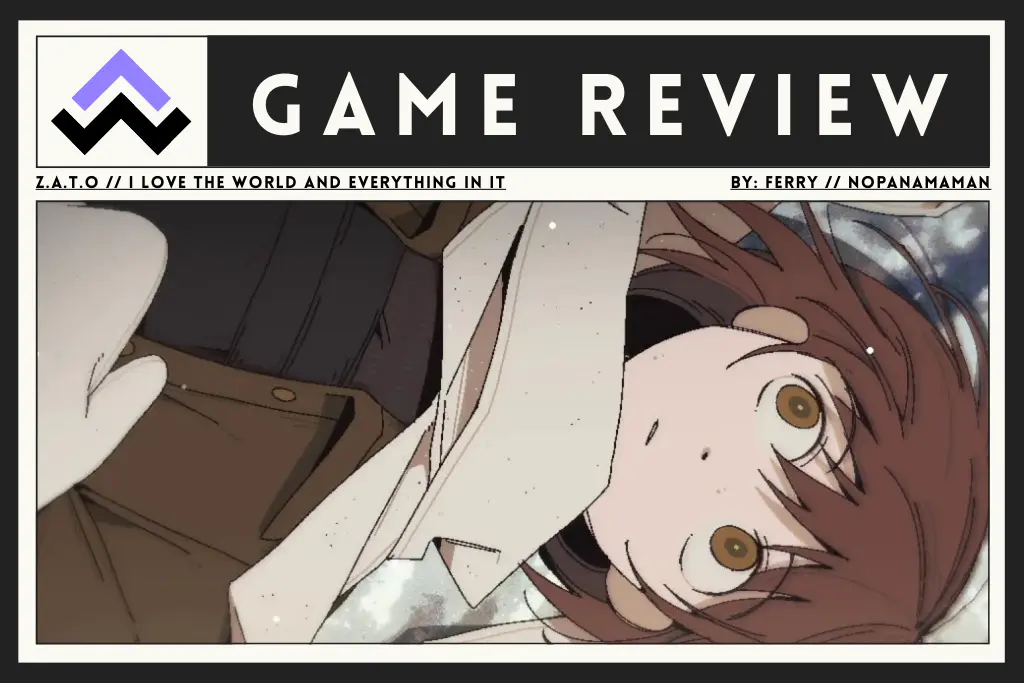

Z.A.T.O. I Love the World and Everything in It is a visual novel that asks a deceptively simple question: what does it mean to exist in a world that refuses to acknowledge you?
For this review, I played Z.A.T.O for roughly six hours in a single playthrough to reach its ending. Unlike Annihilated and most visual novels, this game offers no player interaction or branching choices. It is a kinetic VN with a fully linear structure and a single fixed conclusion.
For players expecting agency, this is the kind of VN where you sit back and let the story unfold. With that in mind, this review focuses on story, characters, and presentation, rather than mechanics or choice-based analysis.
Z.A.T.O // I Love the World and Everything In It Review
Release date: November 11, 2025
Reviewed on: macOS
Time played: 5+ hours
Developer: Ferry // Nopanamaman
Story & Themes
Z.A.T.O is difficult to discuss without spoilers, as its plot and thematic focus are its greatest strengths. At its core, this is a philosophical VN centered on existentialism. While the theme itself is explored at a relatively surface level, its execution is artistically cohesive and effective through metaphor, symbolism, internal monologue, and character–environment interaction.
During my first read, I initially dismissed much of the symbolism and monologue as decorative fluff or scene-setting, such as Asya catching fleeting glimpses of birds in flight. When approaching a newly released indie VN, it’s easy to interpret these moments as overly indulgent narration.
What I failed to recognize at first was that Ferry wrote Z.A.T.O in a manner that feels structurally ready for film or television adaptation, a quality that ultimately reframes its pacing and presentation (and something I quietly hope happens).
Z.A.T.O is set in 1986 in the closed city of Vorkuta-5 in the USSR. “ZATO” («ЗАТО») is a Russian acronym meaning Closed Administrative-Territorial Formation, referring to secret Soviet cities that were heavily guarded and absent from public maps.
I learned this detail through a Reddit discussion while researching the game, and while it isn’t central to the narrative, it reinforces the VN’s tense and uncertain atmosphere, grounding its existential questions in a very specific time and place.
The VN is structured into four parts: a prologue and three episodes. The prologue succeeds by introducing the central theme with restraint, providing just enough context without overwhelming the reader.
Notably, Ferry delivers exposition involving scientific and philosophical concepts without sounding pretentious or breaking the protagonist’s voice.
Where many VNs struggle with tonal inconsistency during exposition, Z.A.T.O avoids this pitfall. Complex ideas are filtered through the perspective of a high schooler in a way that feels natural, accessible, and never condescending.
If you’re looking for the ending for Z.A.T.O. I Love the World and Everything in It explained, consider following us on Discord for future article.
Z.A.T.O. Characters

The protagonist, Asya Subina, initially comes across as a fairly typical VN main character. She is easy to empathize with, yet difficult to fully relate to. She is intensely perceptive, a trait that can be both admirable and frustrating. This perceptiveness is essential to the VN’s existential exploration, even when it makes her internal voice feel emotionally distant.
Asya’s dialogue with other characters can feel unremarkable at times, but her internal monologue is where the narrative truly breathes. Through it, the reader experiences the world as she does: observant, introspective, and acutely aware of her own lack of understanding.
Compared to the supporting cast, Ira Grachevskaya, Marina Kaplan, and Vadim Garin, Asya herself has fewer layers. These characters may initially resemble familiar anime or manga archetypes, but Ferry subverts that simplicity by introducing unpredictability in their motivations.
These motivations do not necessarily invite sympathy or affection. Instead, they contextualize behavior in ways that can make the characters more unsettling rather than more likable.
This approach reminded me of encountering characters like Ami Kawashima (Toradora) or Yukiatsu (Anohana): moments where added context deepens understanding but complicates emotional attachment. Z.A.T.O is less interested in making its characters lovable than in making them legible, and that choice aligns with its themes.
Presentation & Art Direction
Ferry’s art direction is one of Z.A.T.O’s strongest assets. Each character is visually distinct and well-matched to their personality, and the main character’s sprite is particularly impressive given the project’s scale and budget.
The backgrounds serve two clear purposes. First, they immerse the reader in a mid–Cold War USSR aesthetic, enhanced by a grainy and vaporwave-adjacent mood that reinforces the sense of time.
Second, they convince the reader that Vorkuta-5 is a place that genuinely exists. While the environments may appear static or generic at first glance, over time they become spatially legible. You begin to imagine neighborhoods, routes, and how characters move through the city.
The soundtrack consists of freely available music, a fact Ferry is transparent about. Despite this, the selection feels deliberate and emotionally resonant. After finishing the VN, rewatching the intro (which automatically plays on launch) hit with unexpected weight. The music complements the existential tone so well that its origin becomes irrelevant.
Pacing & Length
While many popular VNs span 40–80 hours, Z.A.T.O’s six-hour runtime works to its advantage. Even compared to other acclaimed indie VNs, such as The House in Fata Morgana, Z.A.T.O benefits from its brevity.
Given its fixed structure and lack of branching, a shorter runtime helps maintain narrative momentum and retain the interest of both VN veterans and newcomers. Within this limited length, the VN successfully delivers its central theme and resolves each character’s arc.
Some players on Steam and Reddit have argued that the final chapter feels rushed or could have been expanded. I disagree. The abruptness of the ending feels intentional, designed to linger rather than to resolve neatly. It aligns with the VN’s thematic discomfort.
The pacing may feel slow for players expecting interaction, but it suits Z.A.T.O’s introspective narrative. Certain conversations appear to drag or lack immediate plot relevance, yet in hindsight they add emotional weight to the conclusion.
Technical & Accessibility
I played Z.A.T.O on a MacBook Pro 14, where it ran smoothly overall. Occasionally, advancing dialogue caused the text to restart with altered alignment instead of progressing normally. Whether intentional or not, the effect strangely complements the VN’s transmission-like presentation, though the ambiguity may confuse some players.
Accessibility options are limited. Players can adjust text speed, volume, and control schemes, but there is no dedicated dark mode. Fortunately, the VN’s consistently dark presentation largely mitigates this absence.
Final Verdict: Masterpiece
Z.A.T.O // I Love the World and Everything In It is an existential journey set in the uncertainty of the mid–Cold War USSR. Its linear structure and absence of player choice result in low replayability, but this is a deliberate trade-off in service of a tightly focused narrative.
What makes Z.A.T.O stand out is its thematic cohesion, character writing, and atmosphere. It succeeds not only within the indie VN space, but alongside more prominent titles in the genre.
I strongly recommend this game to both VN fans and those who rarely engage with the medium. For players seeking an unpredictable, introspective story that challenges their sense of purpose and place in the world, this VN is well worth the time.
The Good
- Strong thematic cohesion and atmosphere
- Memorable setting and character writing
- Effective pacing for a kinetic VN
The Bad
- No player agency or branching paths
- Limited accessibility options
- Low replayability
FAQs
No, this is a kinetic visual novel with no branching paths or player choices.
A full playthrough takes approximately six hours.
No, there is one ending and minimal replayability.
The story primarily explores existentialism, identity, and the feeling of existing in a world that feels distant or indifferent.
This experience is best suited for players who enjoy story-driven, introspective narratives. Fans of visual novels and slow-paced psychological stories will appreciate it most, while those seeking heavy interactivity may not.



Respect each other, speak your mind, and focus on ideas, not individuals.