
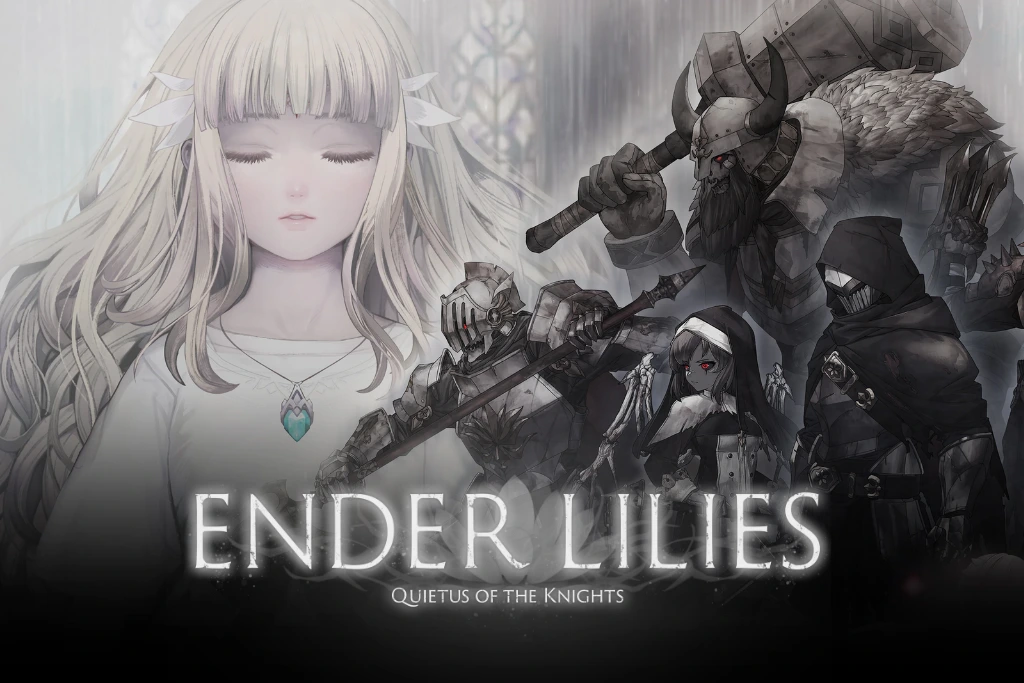

My relationship with Ender Lilies: Quietus of the Knights is a bit different, but it might be relatable to some metroidvania fans. I played it for a few hours, bounced off it, then played its sequel, Ender Magnolia: Bloom in the Mist, and absolutely loved it. So, I came back to Ender Lilies wanting more and ended up falling in love with it.
However, I won’t review Ender Lilies by comparing it to its sequel. You can read our full Ender Magnolia review instead. Here, I’ll focus on how the game holds up on its own, whether it’s still worth playing today, and how the studio performed with its debut title.
Ender Lilies: Quietus of the Knights Review
Release date: 21 Jun, 2021
Reviewed on: Playstation 5
Time played: 17+ hours
Developer: Live Wire and Adglobe
The game has a very interesting premise that fits its gameplay exceptionally well. The Land’s End is a kingdom plagued by the endless Rain of Death. Everything it touches becomes corrupted by the Blight, turning people into the undead.
Lily, the protagonist you play as, is the sole surviving member of the White Priestess lineage. According to the lore, this ancient bloodline possesses the supernatural ability to purify blighted souls.
Although several White Priestesses were meant to protect the kingdom from the undead, you awaken with no memories and soon discover that the entire land has already fallen.
And thus begins your journey.
As a tiny, defenseless girl, you set out to search for the remaining White Priestesses, uncover the truth behind the kingdom’s downfall, and hopefully restore the land to what it once was.
Fighting Through Borrowed Spirits
As you progress through the game, you’ll uncover truths that are even darker than what the visuals initially suggest. It’s a grim but engaging story to follow. What I really appreciate, however, is how closely the gameplay mechanics stay faithful to the lore.
Since Lily is both a priestess and a young child, it wouldn’t make much sense for her to fight through a kingdom full of monsters on her own. You begin with very limited combat and mobility options. As you defeat enemies and purify them from the Blight, their souls become spirits that fight alongside you.

This greatly enhances the immersion, as Lily remains physically defenseless while the spirits she purifies handle the combat. Gameplay-wise, you’re controlling Lily for movement and exploration, but you’re commanding spirits during battles.
At times, Ender Lilies almost feels like a Pokémon game, where you’re constantly collecting new spirits to expand your arsenal. Of course, it wouldn’t be a metroidvania without ability upgrades and previously inaccessible areas that require newly unlocked skills.
The spirit skills themselves are divided into two categories. Some can be used infinitely, while others have limited charges that can only be restored by consuming the rare red flowers scattered throughout the map or by resting at a Respite, the game’s checkpoint system.
This sounds like a great design that encourages different playstyles by balancing stronger abilities with limited usage. However, the game simply isn’t difficult enough to encourage using them. You can comfortably finish the game relying almost entirely on your basic infinite-use spirits.
Even more disappointing is that the limited-use skills, which are supposed to feel stronger, mostly exist for style rather than strategy. Most of the time, they don’t provide enough practical advantage to justify using them. This wouldn’t have been a problem if they excelled in specific situations, such as boss fights, even if those moments were relatively rare. Unfortunately, I never found a point where they genuinely felt necessary.
Exploring the Ruins of Land’s End with a Frustrating Map
The world of Ender Lilies is expansive and beautiful in every way. Combined with its outstanding art direction and haunting soundtrack, it’s easily the game’s greatest strength and the first thing I’d mention when recommending it. Everything perfectly complements the melancholic atmosphere and dark storytelling.
It even reminded me of Hollow Knight, where every region has its own unique identity. You begin in a temple, travel through abandoned hamlets, venture into haunted thickets, descend into eerie catacombs, and even explore underwater areas. Every location feels distinct from the last.
And, in true metroidvania fashion, you’ll revisit many of these areas after unlocking new traversal abilities. Doing so isn’t only necessary for 100% completion, but also rewards you with relics that grant passive bonuses and items that permanently increase your health.
Unlike some exploration games where backtracking feels unrewarding, Ender Lilies usually gives you something worthwhile for revisiting old areas. Unfortunately, that strength is undermined by one of the weakest map systems I’ve used in the genre.
Accessing the map is quick and convenient, and I do appreciate that completed and incomplete rooms are clearly marked based on whether you’ve found all collectibles and hidden paths.
The problem is that every room is represented as nothing more than a simple box.

I was hoping for a more detailed map that showed room layouts, platforms, and walls. Secret passages could remain hidden until discovered, but having some level of detail would make navigation far less frustrating.
Instead, backtracking often feels unnecessarily punishing. Most traversal abilities are unlocked near the end of the game, by which point it’s almost impossible to remember exactly where every inaccessible path was located. Rather than rewarding exploration, the game ended up forcing you to spend extra time rediscovering places you’ve already visited.
The game also doesn’t offer map markers that let you note locations for future revisits. While this would normally help, it wouldn’t fully solve the issue anyway, since the map itself lacks enough detail to make those markers truly useful.
Considering how much time has passed since the game’s release, it’s disappointing that this aspect has never received a meaningful quality-of-life update.
Final Verdict: Good
Ender Lilies: Quietus of the Knights is an impressive debut that still holds up years after its release. Its melancholic world, memorable soundtrack, and clever integration of gameplay with its lore create an experience that’s easy to get absorbed in.
On the other hand, the underwhelming skill balance and frustrating map system prevent it from reaching the same heights as the very best metroidvanias. Neither issue is severe enough to ruin the experience, but both become increasingly noticeable the longer you play.
If you’re a fan of atmospheric metroidvanias with rewarding exploration, strong world-building, and emotional storytelling, Ender Lilies remains well worth playing today. It may not be perfect, but it’s a memorable journey that deserves its place among the genre’s standout titles.
The Good
- Combat mechanics are deeply integrated with the game’s lore
- Atmospheric world with outstanding art direction and soundtrack
- Rewarding exploration with memorable environments and meaningful discoveries
The Bad
- Limited-use spirit skills rarely feel worth using
- Oversimplified map makes backtracking unnecessarily frustrating
FAQs
Yes, despite being several years old, Ender Lilies: Quietus of the Knights remains a strong metroidvania. However, its simplistic map system and underwhelming skill balance may frustrate some players.
A standard playthrough typically takes 15–20 hours, while players aiming for 100% completion can expect to spend around 20–25 hours.
The game offers a moderate challenge. Boss fights can be demanding, but the overall difficulty is forgiving compared to harder metroidvanias.
No, Ender Magnolia: Bloom in the Mist tells a separate story set in the same universe, so newcomers can enjoy it without playing Ender Lilies first.



Respect each other, speak your mind, and focus on ideas, not individuals.