
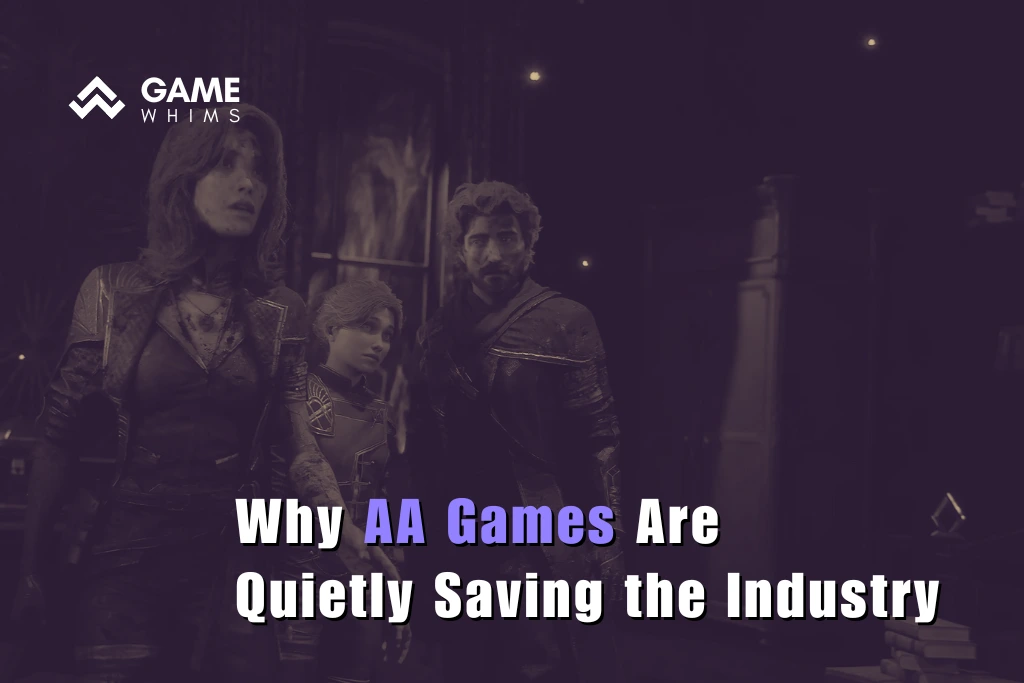

Like movies and films, video games have evolved into an industry split between two extremes: mega-budget blockbusters and tiny indie experiments. Between these poles lies a long-forgotten middle, the AA game. They are not as flashy or as celebrated as big triple-A games, and they lack the underdog charm of indie titles, but AA games have quietly resurfaced as a vital creative force in modern gaming.
For years, this tier was considered extinct. But in a post-Baldur’s Gate 3 and It Takes Two world, AA games are not only back, they might be the key to saving an industry that’s stuck creatively and spending too much money.
✎ SUMMARY
- Skyrocketing costs are making AAA development increasingly unsustainable, stifling creativity and innovation.
- AA games, created by mid-sized teams with modest budgets, are filling the creative void with fresh ideas and tighter experiences.
- Recent hits like Baldur’s Gate 3 and Clair Obscur: Expedition 33 are redefining what success looks like outside the AAA system.
AAA: A Broken System Built on Big Bets
As former PlayStation executive Shawn Layden warned, AAA development has become a game of high-stakes roulette. With ballooning costs often exceeding hundreds of millions, studios are increasingly reliant on sequels, remakes, and proven formulas. “We’re seeing the collapse of creativity,” Layden noted, pointing to a model that punishes risk and rewards familiarity.
Nowhere is this clearer than with Rockstar’s upcoming Grand Theft Auto VI, which, according to IGN, could cost more than €1 billion to develop. These budgets create immense pressure to succeed, which in turn limits creative ambition. Innovation is expensive, predictability is safer.
Besides the money issue, it’s also about time and people. Massive games now take five to ten years to develop, often under intense crunch conditions. The result is a narrower pipeline of releases, reduced experimentation, and an ecosystem increasingly disconnected from players hungry for fresh, original experiences.
The Resurgence of the AA Game
While AAA games chase ever-higher fidelity and market share, AA studios are charting a different course. These mid-budget projects, typically developed by teams ranging from a few dozen to a few hundred, offer a blend of polish and personality. They’re big enough to aim high, but small enough to take risks.
In the 2000s, AA titles like S.T.A.L.K.E.R., Vampire: The Masquerade – Bloodlines, or Kingdoms of Amalur filled the shelves. But during the 2010s, they were squeezed out just like any other double A titles. According to journalist Oli Welsh (Polygon, 2025), the market that once embraced AA became inhospitable as big publishers abandoned mid-tier games in favor of mega-hits.
In recent years, that tide is turning. In 2023, Larian Studios’ Baldur’s Gate 3, a game made outside the traditional AAA system, won Game of the Year. And in 2025, Sandfall Interactive’s Clair Obscur: Expedition 33 has been hailed as another benchmark, proving that smaller teams can still deliver unforgettable, richly crafted experiences.
What Makes AA Games Work?
1. Creative Freedom and Narrative Risk-Taking
Unlike AAA developers beholden to shareholder expectations, AA studios have greater freedom to explore untested mechanics, art styles, and themes. “Thanks to Unreal Engine, it’s now easier to get an idea of the amount of resources you’ll need relative to your production scale,” said Guillaume Broche, creative director at Sandfall Interactive. That control over scope and ambition means AA games can be more nimble and more daring.
Clair Obscur, for example, blends surreal French-inspired aesthetics with experimental turn-based combat. It’s not a game that would likely survive a boardroom pitch meeting at a major publisher, but in the AA space, it thrives.
2. Player Demand for Freshness
Gamers are increasingly fatigued by annual franchises and bloated open-world checklists, take Assassin Creed and Star Wars: Outlaw as examples. Many are turning to AA games in search of more curated experiences. The 28-hour runtime of Clair Obscur, as reported by HowLongToBeat, is a selling point in itself, especially when compared to 100+ hour games filled with filler.
These games also come at a more consumer-friendly price point. Priced under €50 on Steam, Clair Obscur represents better value and a more approachable commitment, both financially and emotionally.
3. Accessibility of Tools and Distribution
Platforms like Unreal Engine, Unity, and Godot have leveled the development playing field. Combined with digital storefronts and subscription services like Game Pass, AA developers can now reach global audiences without the need for massive marketing campaigns.
As gaming marketer Matthias Wehner notes (Medium, 2025), “Digital platforms and tools have removed many of the gatekeeping mechanisms that once kept smaller teams out of the spotlight.” AA studios now have the means and the platforms to achieve much more than expected.
4. A New Kind of Prestige
The prestige once reserved for AAA has begun to shift. Awards, critical acclaim, and player loyalty are increasingly going to titles that embrace vision over volume. Baldur’s Gate 3 wasn’t the most expensive game of 2023, it was simply the best. And that quality, born of freedom rather than budget, is starting to reshape how players and studios define success.
As John Romero noted on Nightdive Studios’ Deep Dive podcast: “When we look at the Game of the Year awards, half the time it’s indies. These people are the ones that make the triple-A companies go, ‘Wait a minute. We need to start doing this.’”
The Challenges AA Studios Still Face
Despite their promise, AA games face steep uphill battles. With smaller budgets, these titles often lack the polish expected by modern audiences. They’re judged against the same benchmarks as blockbusters, despite having a fraction of the resources.
Maximilian Padilla-Rodriguez (HowToGeek, 2025) writes that this leads to mixed receptions: “While many aim to replicate AAA experiences, they are frequently judged by the same standards… leading to technical limitations and mixed reception.” Players expect AAA quality, even when buying a €40 game made by 60 people.
There’s also the discoverability problem. Without the marketing power of giants like EA or Activision, even the best AA games risk being overlooked. Word of mouth, influencer coverage, and inclusion in subscription libraries are crucial, but still unpredictable.
And, of course, not every AA game is a hidden gem. The same risk-taking that fuels creativity can also lead to uneven design, janky performance, or narrative misfires.
What the Future Might Hold
Still, the future for AA looks bright. As development costs for AAA games spiral further out of control, the economic logic of AA becomes more compelling. “We’re likely to see an increase in companies like ours,” said Guillaume Broche. And not just for financial reasons, but creative ones as well.
According to Matthias Wehner, embracing the AA model allows for “more diverse types of games, more frequent releases, and more sustainable development cycles.” In other words: more of the good stuff, more often, without destroying the people who make it.
Even AAA studios are starting to notice. Some are spinning up smaller internal teams to experiment with AA-like projects. Others, like Xbox Game Studios, are partnering with mid-sized developers to diversify their portfolios.
And players are responding by showing up, playing, and celebrating these games when they deliver. The message is clear: scale isn’t everything, but vision is.
Final Thoughts
AA games are necessary recalibration for an industry that’s drifted too far into excess and too far from innovation. In a landscape dominated by sameness, these titles offer something rare and surprising.
They remind us that great games don’t need €1 billion budgets or decade-long development cycles. They need ambition, clarity of vision, and the willingness to take a leap, even if it’s a smaller one.
As the industry rethinks what success looks like, the middle ground is emerging as a quiet but powerful force, shaping what comes next.
ENJOYED THIS PIECE?
Add GameWhims as a preferred source on Google.
Jump to:

Respect each other, speak your mind, and focus on ideas, not individuals.