
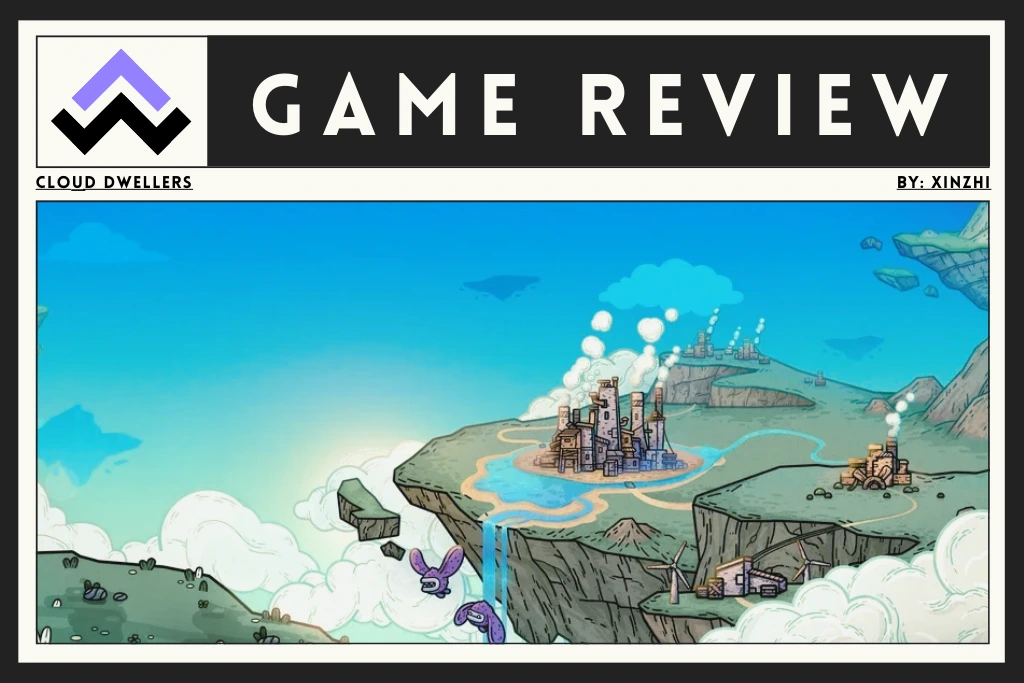

When I first launched Cloud Dwellers, I expected to poke around for half an hour and move on. Instead, I lost an entire evening to what is technically “just” a demo. Not to disaster spirals or looming collapse, just to the quiet satisfaction of building at my own pace.
Cloud Dwellers is a colony sim set across drifting islands in the sky. You harvest, build, expand, and manage a small band of workers. It sounds familiar and feels almost calm, but it is a base-builder that swaps survival anxiety for creative logistics and experimentation.
Cloud Dwellers Review
Release date: Q2 2026
Reviewed on: Windows
Time played: 3+ hours
Developer: XinZhi
A Colony Sim Without the Panic
If you’ve played Oxygen Not Included, you know the constant dread of suffocation and cascading system failure. If you’ve dabbled in Ark of Charon, you’re used to combat pressure and defensive positioning shaping your builds. Cloud Dwellers eliminates these from their gameplay.
The loop is simple, you harvest materials, construct facilities, feed your workers, expand to neighboring floating islands. Your units need food and rest, and poor nourishment reduces efficiency, but failure rarely turns into disaster.
Where most colony sims weaponize stress to drive momentum, Cloud Dwellers leans into aesthetic expression. If you’ve got the resources, you can decorate, build elaborate layouts, optimize for beauty rather than survival. It’s oddly liberating to construct something because you want it to look good, not because a red warning icon demands it.
The risk, of course, is that this type of gameplay can lead players into aimlessness. But Cloud Dwellers has a trick up its sleeve.
Glimmerwave: The Light that Powers Everything
The game’s defining mechanic is a mysterious glowing stone called Glimmerwave. It can only be activated by a unit with sufficient level of intelligence. Once triggered, it emits a vertical beam of light, effectively this world’s version of electricity.
You craft mirrors instead of wires, and align them to redirect the beam toward devices. Line them up properly, and you can automate production lines, boost efficiency, and reduce manual labour.
Misalign them, and your beautifully planned base becomes a mess of awkward angles and exposed light paths.

In its own way, it reminded me a lot more of Minecraft’s redstone logic than traditional power grids. The moment I automated my first harvesting setup, bouncing a beam across three mirrors to power a harvester, the game shifted from “pleasant builder” to “clever toybox.”
The mirrors are functional, but they’re also intrusive. They cut through your carefully curated layouts. It really demands a lot of gives and takes. In a way, Glimmerwave introduces friction if you’re prioritizing aesthetics.
Moreover, the procedural island generation keeps each run slightly off-balance. Biomes range from arid desert platforms to icy tundras where each introduces new materials and build possibilities. There’s also ancient statues scattered across the map, providing temporary buffs to nearby workers which encourage you to cluster certain economic activities in specific locations. Suddenly your pretty base has to negotiate with geography.
The result is a colony sim that’s more about spatial problem-solving than survival optimization.
Growth Without Breeding
To add to what is already a unique gameplay, expansion works differently here too.
Rather than breeding or recruiting, you begin each run with a handful of units. Five by default, probably fewer on higher difficulties. To grow, you must locate and open cryogenic pods scattered across the islands.
Rescuing these sleeping colonists becomes quiet a priority. However, the game does not demand you to scale nor expand, but growth meaningfully accelerates your ambitions. More hands mean more builders for construction, more time to explore, and more researcher to experiment.
Interestingly, the game never punishes you for staying small. You can progress slowly and methodically. But if you push too far without managing food quality and supply, the efficiency drops. There’s a gentle push-and-pull between expansion and sustainability, which is enough to create tension without ever tipping into chaos.
The Joy and Danger of No Guidelines
The boldest design decision is the absence of a real tutorial. Beyond basic UI explanations, Cloud Dwellers won’t tell you what to do. There’s no task list, objective markers, not even any flashing suggestions.
On my first run, I watched my workers chop wood until storage overflowed and they slowed down from hunger. I had no idea wood could be used to craft ladders to reach neighboring islands. When I eventually found mushrooms, I let my units eat them raw, completely unaware that cooking them into soup is the way to go.
The best aspect of the game is that it teaches us through failure and discovery instead of instruction. This design philosophy will either delight or repel you. It recalls my early Minecraft experience, that slow accumulation of knowledge, the satisfaction of figuring something out without a tooltip holding your hand.
Each biome unlocks new materials and new confusion. Every discovery widens the possibility space, and briefly makes you feel incompetent again. But it’s also the game’s biggest barrier. With a small community and limited guides available, newcomers may bounce off the opacity.
A Demo that Already Feels Substantial
It’s worth remembering that this is still a demo build, with early access planned soon. Certain systems like hobbies, deeper skill trees, and expanded transport networks remain locked or incomplete. Not to forget that higher difficulty modes are yet to be fully explored.
And yet, even in its current state, Cloud Dwellers feels robust. The Glimmerwave system alone suggests enormous room for expansion. More automation complexity, more environmental constraints, more creative tools… all seem like plausible next steps.
The question is whether the game can maintain its balance as it grows. If the devs add too much pressure, it risks becoming every other stress-heavy colony sim. Adding too little, on the other hand, could curdle into stagnation.
Final Verdict: Good
Cloud Dwellers is a sandbox about crystal light, spatial space, and gentle problem-solving. Its greatest strength is the low-tension, aesthetic-first gameplay. Its greatest risk is that some players may crave sharper stakes.
If you enjoy discovering systems the hard way, tinkering with automation, and building for beauty as much as efficiency, this is already worth your time even in demo form. If you need structured objectives and constant urgency, you may find yourself staring at your floating island wondering what you’re meant to care about.
The Good
- Strong aesthetic freedom
- Low-stress colony sim design
- Innovative Glimmerwave system
The Bad
- Minimal guidance
- Lacking stakes and tensions
FAQs
No, unlike harsher sims, it avoids cascading disasters and focuses more on creative logistics than survival pressure.
Glimmerwave emits a beam of light that acts as power. Instead of wiring systems, you craft mirrors to redirect the beam to machinery, enabling automation through spatial planning.
Only minimal UI guidance. The game expects players to experiment and discover mechanics organically, which can be rewarding or overwhelming.




Respect each other, speak your mind, and focus on ideas, not individuals.