
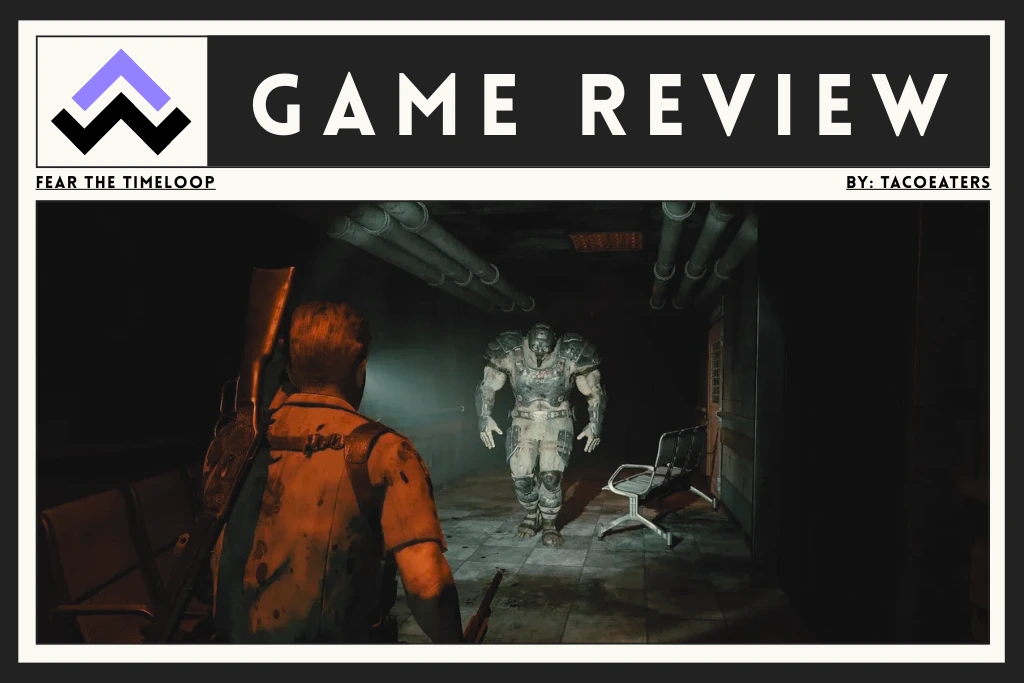

Fear the Timeloop traps you in a nightmarish hospital where every death resets your progress, but your memories persist. You play as a sheriff hunting a serial killer, only to wake up in a hospital with 15 minutes to live.
Fear the Timeloop Review
Release date: January 30, 2026
Reviewed on: Windows
Time played: 7+ hours
Developer: TacoEaters
You’ll notice a stark resemblance to Resident Evil 2 (2019) almost immediately, within the first 30 minutes of gameplay. The similarities go beyond the clean HUD and over-the-shoulder shooting mechanics. The level design, and especially the main hall, is downright parallel.
Nonetheless, the game feels more like a tribute to the classic survival horror franchise rather than a not-so-subtle attempt at plagiarism. And that is not a bad practice, hence why we ranked this as one of the best indie horror games. One of the developers also mentioned in a demo gameplay video that the game is heavily inspired by Resident Evil 2, along with a few other titles.
Therefore, it’s only fair to evaluate this Fear the Timeloop review as an RE-inspired game, focusing on whether those familiar elements enhance the experience, how well the original plot holds up, and how the time-loop mechanic (its most unique feature) sets it apart.
The Fundamentals of Survival Horror
If you’re already familiar with survival horror games like the Outlast franchise, but less so with the zombie-shooting genre, you’re not completely powerless in Fear the Timeloop. The game offers a modest selection of weapons and the ability to heal injuries, but ammunition and bandages are scarce, forcing you to be conservative with your resources.

While mastering resource management drastically improves survivability, you’re not handed weapons or health kits at the start. Instead, you’re encouraged to explore each room in search of supplies, never knowing if danger lurks behind a closed door. The availability of resources also changes depending on the difficulty setting chosen at the beginning of the game.
Certain weapons require you to complete intricate puzzles that are genuinely fun to unravel, though their complexity often depends on which documents you’ve discovered, and whether you’ve taken the time to read them.
Fear the Timeloop will likely appeal to players expecting combat, resource management, and exploration similar to the Resident Evil franchise. That said, don’t expect over-the-top firepower as weapons are limited to basics like handguns and shotguns rather than flamethrowers or anti-tank rockets. And if you ever find yourself completely out of ammo, there’s always a police baton as your last-resort option.
Time Loop Reinforces Learning Through Failure
Fear the Timeloop gets the fundamentals of survival horror right, but its time-loop mechanic is what truly sets it apart from its genre peers, even beyond the indie space. If you enjoy horror games that play with repetition and uncertainty, check out our Backrooms Anomaly review.
Your fatal wound will kill you in 15 minutes, and any injuries sustained during a run further reduce that time. This means you must complete your objectives and possibly escape the haunted hospital within a strict time limit, all while avoiding additional damage from lurking zombies.
Upon death, you return to your last save point, resetting all physical progress. While this may initially seem like a standard restart-on-death mechanic, the loop becomes far more deliberate as the game unfolds.
You soon discover that you’re trapped in this cycle by an unknown force, with both the culprit and their motives gradually revealed over time. Memories from each run carry over into the next loop. Information learned from documents, character abilities acquired, and unlocked areas of the map all persist, allowing you to plan each subsequent run more efficiently.
💡 NOTE
New voice line plays after reset showing your character is aware he is in a loop.
To illustrate how the time loop meaningfully impacts gameplay, let’s take a look at the recurring two-room dilemma. You’ll often encounter two locked doors with a control screen between them, allowing you to unlock only one and permanently locking the other for that loop. With no indication of what lies behind either door, the decision is based purely on intuition.
The only way to access the other room is to die and reset the loop. For the sake of this review, I tested both options whenever this scenario appeared, and the rewards behind each door proved crucial to progression, whether through essential supplies or missing documents needed to solve puzzles.
You can intentionally force death until you’re satisfied with your choice. All acquired knowledge, excluding physical supplies, always carries over between loops. Fear the Timeloop did amazingly well at reinforcing the game’s emphasis on learning through failure.
Originality in Plot & Zombie Designs
The hospital layout and many zombies are heavily inspired by the RE franchise. Crawling, disfigured zombies clearly nod to RE2’s Lickers. However, there are notable original elements that deserve attention.
If you’re expecting to mow down hordes like in Days Gone or Left 4 Dead, this game isn’t for you. Standard zombies usually appear in small groups of three and can be managed even with melee combat. There is one instance where you must survive three waves of zombies, but it’s far from the nonstop bullet-fest of traditional zombie shooters.

Nonetheless, a few special variants scattered throughout the map keep encounters tense. One of the most memorable is a fire-spitting zombie, carrying a jerry can in one hand and dragging a thurible in the other. Others are translucent zombies, extremely difficult to spot in tight spaces.
The most horrifying variant, however, is the Clown. While not particularly unique or powerful, its echoing laughter down the corridors is unnerving. Even when you can anticipate it, the sound never fails to send chills, no matter how many times you encounter it.
The zombies’ presence ties directly into the plot. Progressing through each chapter requires finding VHS tapes, which also function as checkpoints for the next loop. Each tape reveals aspects of demonology. Without spoiling too much, the plot is both believable and justifies the time-loop mechanic. The developers have also revealed that the story is derived from a short story written by Alexandr Fandeev, the game director.
The Truth About 15-Minute Gimmick
One thing I didn’t notice until replaying on a higher difficulty is the genius behind the health bar display. On Easy, your health is always visible via a clean HUD. On higher difficulties, however, this is completely removed. Instead, you must check your current status by selecting your watch from the radial menu, which shows how much time remains until death.
While this is a unique feature that adds immersion to the survival aspect, the premise of surviving only 15 minutes can feel exaggerated. Consuming any health supply immediately restores lost minutes, and progressing to the next chapter resets the timer entirely. In practice, the 15-minute limit is largely symbolic, but it still emphasizes careful resource management and reinforces tension in each run.
Final Verdict: Great
Fear the Timeloop succeeds at balancing homage and originality. While the game clearly draws inspiration from Resident Evil 2, it leverages familiar mechanics to deliver a satisfying survival horror experience. Where it truly stands out is the time-loop mechanic, which cleverly reinforces learning through failure, encouraging players to experiment, explore, and make calculated decisions under pressure.
The game’s plot and zombie designs complement its gameplay loops. Special zombie variants, like fire-spitting enemies or the unsettling Clown, add tension without overwhelming the player, and the VHS tapes provide both narrative context and functional checkpoints, giving purpose to the repeated loops. Even the 15-minute “gimmick,” while somewhat exaggerated in practice, contributes to immersion and resource-conscious play.
Bottom line: Fear the Timeloop is a tense, rewarding survival horror experience that turns every death into a lesson, making homage feel fresh.
The Good
- Zombies and level design create real tension
- Time-loop mechanic encourages learning through failure
- Puzzles are clever that make exploration feel meaningful
The Bad
- 15-minute timer is mostly symbolic
- Some homage elements may feel too familiar
ⓘ Review Disclaimer
GameWhims is partnered with GamePinata. While we received a free copy of this game, our review reflects our honest and unbiased opinion.
FAQs
Fear the Timeloop features a time-loop mechanic where every death resets physical progress but retains knowledge, documents, and unlocked areas.
The 15-minute limit is mostly symbolic, especially as progress to the next chapter resets the timer. Difficulty comes more from managing resources, zombies, and exploration than the clock itself.
No, familiarity with RE2 enhances the experience but isn’t required. New players can enjoy the tension, exploration, and zombie encounters without prior RE knowledge.
Combat is limited to basics like handguns, shotguns, and a police baton as a last resort.





Respect each other, speak your mind, and focus on ideas, not individuals.