
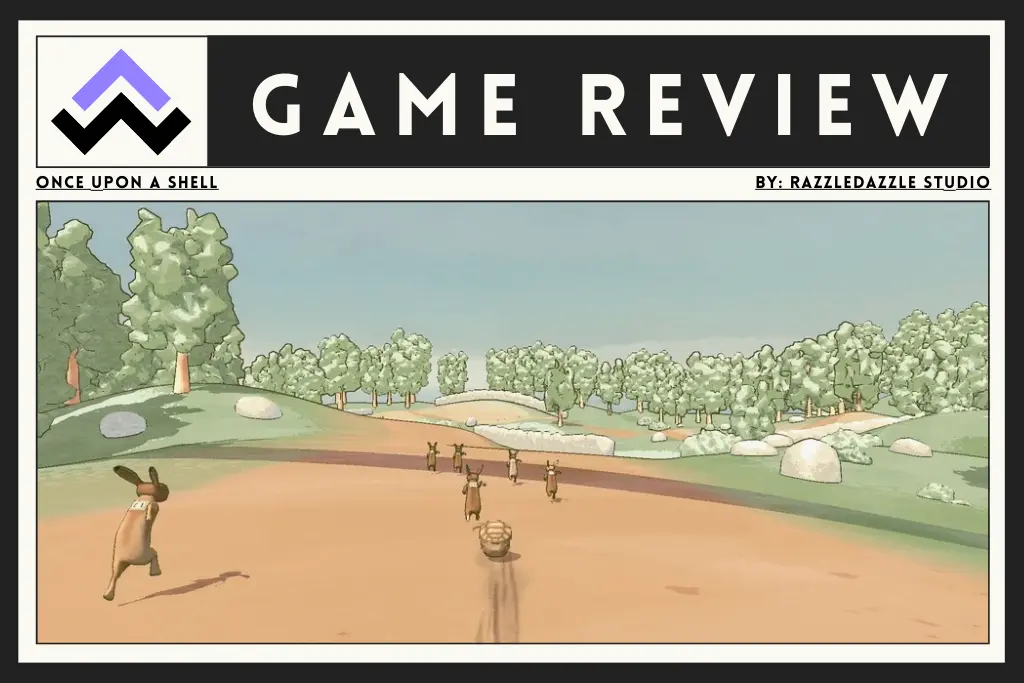

Once Upon a Shell takes the classic tale of The Tortoise and the Hare and turns it into a roguelite racing game, where persistence and smart upgrades are meant to close the gap between you and a group of absurdly fast hares. It’s a charming premise, but one that struggles to justify its structure beyond its final moments.
Developed as part of the DADIU 2025 program in Copenhagen, Once Upon a Shell is a student-made project. But for the sake of this review, I judged it purely as a finished game, not an academic exercise.
Once Upon a Shell Review
Release date: December 26, 2025
Reviewed on: macOS
Time played: 30+ minutes
Developer: Razzledazzle Studio
You play as the tortoise, competing in a loop of four races to win the Hare Cup. Lose a race, and your run ends immediately. Win, and you’re offered a choice of upgrades before moving on to the next track. There’s no meta-progression and no permanent unlocks, where every run starts from scratch.
On paper, that’s a solid foundation within a small but growing niche of roguelite racers, such as the upcoming Reality Drift and the Early Access title SCHROTT. In practice, it rarely leads to interesting decisions.
Simple Racing, Limited Learning
Once Upon a Shell is approachable to a fault. Your tortoise has a base speed of roughly 18 m/s, while the hares push past 30. You can jump, drift, and build speed, but none of these mechanics feel essential nor particularly rewarding in the early races.
The handling works well enough, but it lacks the responsiveness or depth you’d expect from even modest arcade racers. Compared to genre staples like Mario Kart, the controls get the job done but never feel especially fun or expressive. You’re rarely asked to master the track or experiment with advanced techniques, just to hold forward and avoid obvious mistakes.
That simplicity makes the game easy to pick up, but it also undermines the core roguelite loop. Losing a run never feels like a learning experience. After several failed attempts, I wasn’t asking what I should do differently, I was asking whether retrying was worth it at all.
Upgrades That Don’t Change How You Play
Between races, you’re offered randomized upgrades, but most of them are straightforward stat boosts: higher base speed, reduced drift penalties, or minor acceleration tweaks. These upgrades rarely alter your approach to racing, and in the first three races, they often feel unnecessary altogether.

There are a few exceptions. Rock Smasher, which prevents slowdown when colliding with obstacles, sounds impactful on paper. But in practice, collisions are so rare that its effect is barely noticeable. As a result, upgrade choices feel inconsequential rather than strategic.
Without upgrades that meaningfully reshape your playstyle, permadeath loses its teeth. Starting over doesn’t invite experimentation but it simply resets your patience.
Confusing Track Variety
Track design is one of the game’s weakest points. Once Upon a Shell doesn’t clearly communicate whether its tracks are procedurally generated or manually curated, and the result is a sense of disorientation rather than discovery.
Maps often feel familiar until a sudden turn suggests you’re somewhere else entirely. After multiple runs, it’s still difficult to tell whether you’re racing variations of the same track or an extremely limited set of layouts. Either way, the lack of clarity hurts replayability and makes each run blur together.
The Final Race Finally Comes Together
Ironically, Once Upon a Shell only fully clicks in its final race.
Here, the track opens into multiple branching paths, each favoring different upgrades and racing styles. Some routes reward momentum builds from sliding down hills or ramps, while others are shorter but packed with obstacles. Wind gusts appear for the first time, offering speed boosts and encouraging riskier decisions.

The hares are faster, the pressure is higher, and suddenly your upgrade choices actually matter. For the first time, skill and strategy align, and the game becomes somewhat exciting.
Unfortunately, reaching this moment requires pushing through several repetitive races that never demand the same level of engagement. Once the run ends, win or lose, you’re sent straight back to the beginning.
Bugs, Balance, and Missed Opportunities
Several hares frequently behave erratically, occasionally turning around mid-race and heading back toward the starting line. While I find it amusing at times, these bugs make the game even easier than it already is.
The game is exclusively single-player, which feels like a missed opportunity. A local multiplayer mode or time-trial leaderboards could have added longevity and rank it among the best games for couples, even if figuring out who plays as the tortoise or hares required devs to have some outside the box solution.
Final Verdict: Average
Once Upon a Shell is a charming idea held back by underdeveloped systems. Its roguelite structure lacks the depth needed to make repetition rewarding, and its racing mechanics never evolve enough to sustain long-term interest. While the final race hints at a smarter, more dynamic game, it arrives too late and demands too much repetition to reach again.
Players looking for a light, low-pressure racing experience may find some enjoyment here. Those seeking meaningful progression or replayability will likely give up long before the shell crosses the finish line.
The Good
- Simple and approachable gameplay
- Creative twist on The Tortoise and the Hare
The Bad
- Races feel repetitive and unrewarding
- Fun only fully emerges in the final race
- Upgrades rarely change gameplay or strategy
FAQs
It’s a roguelite racing game that adapts the classic Tortoise and the Hare story, where you play as the tortoise competing in fast-paced races against hares.
Each run consists of four races, with failure ending the run immediately. Completing a run takes roughly 10 minutes, depending on player skill.
No, Once Upon a Shell is single-player only, and there are currently no time-trial leaderboards.
Yes. The game can be frustrating in early races due to repetitive tracks and inconsequential upgrades, but the final race introduces more strategic depth and challenge.


Respect each other, speak your mind, and focus on ideas, not individuals.