

Several weeks ago, a colleague of mine described a game that intentionally misled him. Monster Girl Therapy lure a very specific audience by using suggestive character design and marketing material, only to subvert those expectations in its final arc with a meta-commentary on the very community it attracts.
It brings a kind of impact that doesn’t come from storytelling alone. Players realize they’ve been complicit in the setup all along.
Moments like that are rare. Most games, especially big-budget titles, still rely on familiar, cinematic storytelling structures. Character development is presented through cutscenes, dialogue, and scripted arcs. You watch characters grow, and you learn themes through observation.
But what happens when a game makes you go through that growth instead of just showing it?
I spent some time looking into this and found a smaller group of works that approach character and theme differently. Rather than using mechanics to support narrative, they use mechanics to produce it.
Papers, Please is a good example. It begins with a mundane task of approving or denying entry at a border checkpoint. At first, you’re motivated to do the job correctly because mistakes cost you wages, and your goal is to support your family by paying rent, utilities, and medical bills. As the days progress, the game introduces increasingly complex situations, revealing why some people have incomplete or falsified documents. You begin making decisions that go against the system’s original expectations. What starts as routine gradually becomes moral tension, and that friction becomes thematic expression.
You can find a similar approach in larger-scale productions like Death Stranding. Every system in the game is built around the idea of human connection. But Hideo Kojima isn’t interested in players simply recognizing that theme. He wants them to personally feel it. Through its mechanics, the game places you in Sam’s position as an isolated courier, where connection is something you gradually come to value through play.

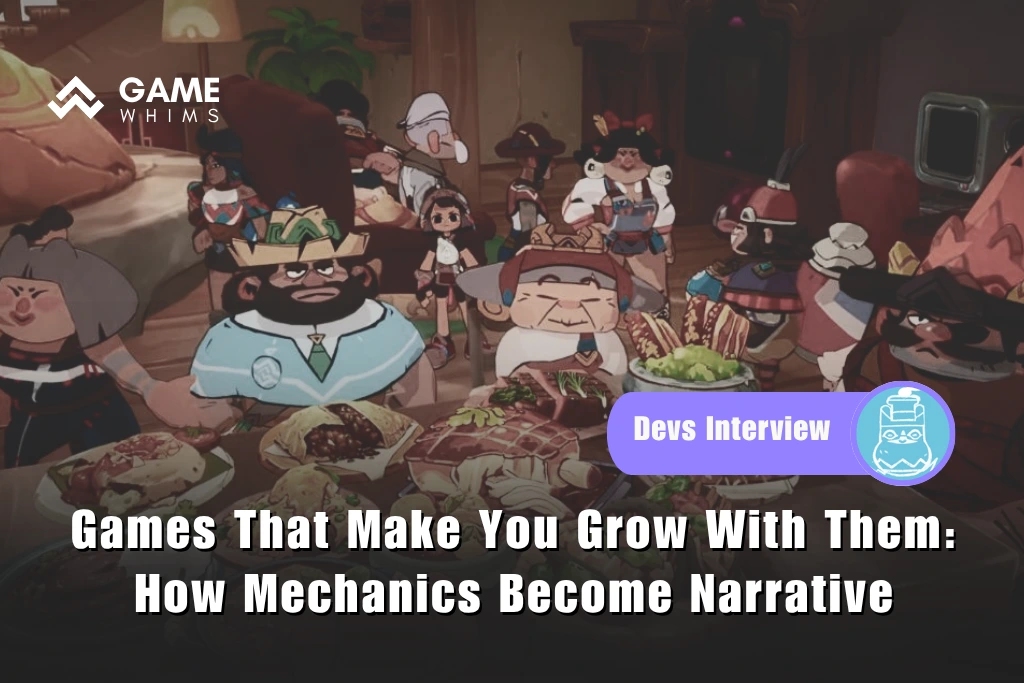
I recently reviewed Town of Zoz, which operates within this lineage, though its method is more subtle. I also had the opportunity to speak with the developers about this design philosophy.
At first glance, the game adopts the language of life simulation. Its early gameplay is the same rhythm of Stardew Valley and similar titles. You farm, cook, run errands, and repeat daily routines. The tone is warm, the systems are accessible, and the structure is immediately legible.
Yet with extended play, a different intention emerges. The opening is slow, yes, but it is designed to mislead players.
“The slower exposition in the start of the game is purely intentional,” the developer explains. The goal was to create something recognizable—particularly for players familiar with Japanese RPGs and farming simulations—while quietly steering the experience elsewhere. “I wanted to make a game that leads the player to believe it’s something that it kind of isn’t.”
Unlike many narrative-driven games, this misdirection comes from mechanical emphasis instead of a plot twist. Players spend hours tending crops, managing ingredients, and traveling between locations. These actions can feel excessive, even unjustified, in the early hours.
Their purpose isn’t immediately clear, which crucially mirrors the protagonist’s own position.
Ito, the game’s central character, is subjected to routine by a strict parent who insists on the importance of chores without explanation. “We don’t know why we have to do things,” the developer says. “We just know we have to do them.” Only later do both the character and the player come to understand their value.
Over time, you’ll naturally reinterpret the game’s systems. Activities that once feel optional or extraneous become essential to survival and progression. The shift is of course made gradually and cumulatively, but it creates meaning through continuous engagement with the game’s mechanics.
By the time the game reaches its turning point, the player and character are already aligned in a way narrative alone rarely achieves. Ito’s arc, from frustration to understanding, is now enacted by both character and player.
The developer puts it in experiential terms: players are meant to “grow up” alongside the protagonist, reassessing earlier assumptions as new challenges arise. What begins as resistance turns into adaptation. What once felt trivial becomes necessary. The player’s evolving relationship with the game’s systems becomes the arc itself.
That said, this approach carries risks. A design built on delayed meaning depends heavily on player retention. If the early hours are perceived only as friction, especially by players expecting immediate action, many may disengage before that recontextualization takes place. “There was a lot of mixed feedback,” the developer noted. “Some people liked the pacing… others were surprised by how much there was at the very beginning.”
Still, despite these challenges, Town of Zoz points to a broader possibility within the medium. It shows how mechanics can function as a narrative instrument, rather than just interactive scaffolding.
Where traditional storytelling asks players to interpret a character’s development, this approach asks them to undergo it. In this sense, misdirection becomes a method of engagement. By allowing players to misunderstand, resist, and ultimately reassess, games like Town of Zoz, Papers, Please, and Death Stranding highlight a uniquely interactive form of storytelling.
One defined not by what is shown, but by what is learned through play.

Respect each other, speak your mind, and focus on ideas, not individuals.